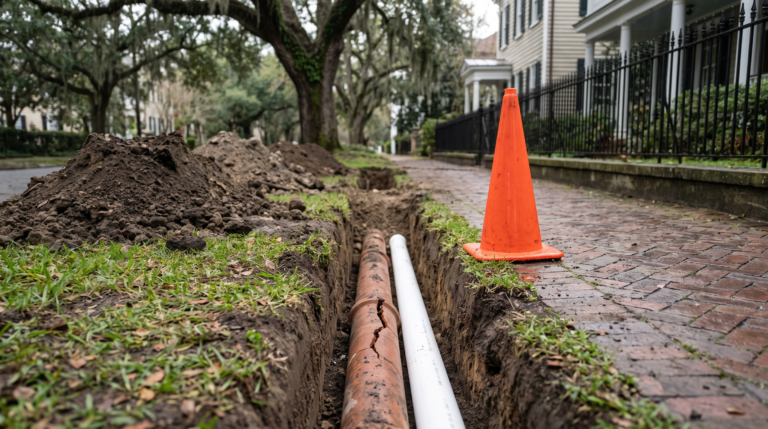
Shut the water off first. The main shutoff for most Charleston homes sits where the supply line enters the house or in the meter box near the street, and a water heater or a single fixture usually has a closer valve of its own. Then ask whether the problem is spreading. A spreading problem needs an emergency plumber. Charleston, SC homes fail in ways that follow the ground they sit on, and this guide sorts the 2 a.m. calls from the ones that can wait for daylight.
Start With the Shutoffs, Before Anything Else
Nearly every plumbing emergency gets smaller the moment the water stops moving. Find these three things while the house is dry and the lights are on, then write the locations on a note taped inside your breaker panel door. A neighbor or a house sitter should be able to read it and act on it.
The main water shutoff
In older houses downtown, in Wagener Terrace, and across West Ashley, the main valve is usually inside, close to where the supply line comes through the crawl space or foundation wall, often near the water heater or a utility sink. In newer Mount Pleasant, Daniel Island, and Summerville builds it tends to sit in a wall box in the garage or on an exterior wall. Every home also has a valve at the meter box near the street, which needs a meter key or a solid pair of pliers. A round handle turns clockwise, and it takes several full turns to close. A lever-style ball valve needs only a quarter turn.
Old gate valves seize in place. If you have never turned yours, try it gently on a Saturday afternoon rather than at midnight. A valve that will not move, or one that weeps once it does, is a repair worth scheduling on its own rather than discovering during a flood.
The valve closest to the problem
You do not always need the main. Toilets have a stop behind the bowl, sinks have stops under the cabinet, and a water heater has a cold-water valve on the pipe entering its top. Closing the nearest valve stops the damage and keeps the rest of the house in water while you wait for a plumber.
Power and gas to the appliance
If the trouble is at the water heater, cut its energy before you drain anything: the breaker for an electric unit, or the gas control knob turned to the off position for a gas one. An electric element that fires in an empty tank burns out within minutes, which turns a tank problem into a parts problem on top of it.
When You Need an Emergency Plumber in Charleston, SC Tonight
The test is simple. Is water going somewhere it should not go, is waste coming back toward you, or is there a hazard you cannot contain? Any of those is a call now rather than in the morning.
- A burst or spraying supply line. Copper splits, old galvanized pipe fails at the threads, and a hose bibb can crack after a hard freeze. Close the main, then call.
- Water coming through a ceiling or running down a wall. You are seeing the end of the path, not the start of it. Drywall holds water until it does not, and a sagging, saturated ceiling is a falling hazard.
- Sewage backing up into a tub, shower, or floor drain. Stop using water anywhere in the house and keep people and pets off the wet floor.
- A water heater leaking from the tank itself. A tank that has rusted through does not stop on its own. Attic and upstairs closet installs are common here, and that water lands on ceilings and insulation.
- No water at all, with no notice from your utility. A broken service line between the meter and the house can run for hours into the ground before anything shows at the surface.
- The smell of gas, or a hissing line. This one has its own sequence, below, and the plumber is not the first call.
- Water near a panel, an outlet, or a light fixture. Shut off the circuit if you can reach the panel without standing in water, and stay out of anything standing.
Two more worth knowing: a leak that shows up only when one particular fixture runs is still urgent if the pipe is inside a wall, and the sound of running water with every fixture closed means something is losing water right now.
What Can Usually Wait Until Morning
Calling after hours for something that is not moving costs you a night of sleep for no gain. These can generally hold until business hours, as long as nothing changes:
- A faucet that drips, or a showerhead that weeps after you shut it off.
- One slow drain, with the rest of the house draining normally.
- A toilet that keeps running, once you close the stop behind it.
- A garbage disposal that hums or stays silent, with the sink not backing up.
- Water that is not as hot as it used to be, with no leak and no smell.
- A small drip at a shutoff that a bucket and a towel are catching.
Keep an eye on them anyway. One slow drain is a fixture problem. Two or more slow drains on the same side of the house usually means the trouble is farther down the line, and that moves it up the list. Water rising in a toilet when the washing machine drains is the same signal. Our guide to sewer backups in Lowcountry homes covers what a camera finds in those cases and what the repair choices look like.
A Gas Smell Is Not a Plumbing Call First
If you smell gas, hear hissing near a line or an appliance, or a detector sounds, get everyone out of the house first. Do not flip switches, do not unplug anything, do not use the stove, and leave phones alone until you are outside and well away from the building. Switches and phones can be a source of ignition, which is why published utility guidance puts distance ahead of any phone call.
From a safe distance, call your gas utility’s emergency number or 911. Their job is to shut the gas off and contain the danger. Once the utility has made the property safe, a plumber comes in to find and repair the fault in the gas system itself. That order does not change because it is late. Charles Towne Plumbing handles gas line repair and replacement after the danger is contained, including the pressure test that follows the repair.
Do not relight a pilot light yourself after a leak, and do not let anyone back inside until the utility says the house is clear.
Sewage Backing Up Is a Health Hazard, Not an Inconvenience
A backup brings wastewater and the pathogens in it, including bacteria, viruses, and parasites, into the part of the house where your family walks barefoot. Children, older adults, and anyone whose immune system is suppressed by illness or treatment face a higher risk from that exposure, and they belong out of the affected rooms entirely until the cleanup is finished. This is not a mop-and-forget situation.
While you wait: stop running water, including the dishwasher and the washing machine, because every gallon you send down adds to what comes back up. Close the bathroom door. Open a window. Wear boots and gloves if you have to go in at all. Porous things that got wet, such as bath mats, cardboard, and carpet pad, usually do not come back.
Finding the cause takes eyes inside the pipe. A sewer camera inspection shows whether the line is blocked by grease, root intrusion from a live oak, a collapsed section of cast iron or clay, or standing water in a low belly where the ground has settled. It is also how you tell a one-time clog from a line that will do this again next month.
Where the pipe itself has failed, the repair does not have to mean a trench across a historic yard or a brick driveway. Charles Towne Plumbing does its trenchless pipe lining in house through its sister company, Carolina Relining Solutions, which cures a new liner inside the old pipe and verifies the finished line with a camera afterward.
Water Heaters Pick the Worst Hour
Water heaters tend to fail when the house is asleep, and in the Lowcountry they often sit in an attic or an upstairs closet, which is the most expensive place for a tank to open up. A drain pan helps only if its drain line is clear, so check that the pan is dry and the line is open the next time you are up there for something else.
A drip at a fitting, a release from the temperature and pressure relief valve, and a rusty weep at the bottom seam each mean something different. A tank leaking from the shell is finished. Our page on water heater repair explains what can be fixed and what cannot, and the post on the signs a water heater is near the end covers rusty water, popping sounds, and a recovery time that keeps getting longer.
Two things are worth checking tonight. The Department of Energy’s guidance for household water heaters is a thermostat setting of about 120 degrees Fahrenheit, which also lowers the risk of scalding a child at the tap. And the relief valve’s discharge pipe needs to point down and end near the floor, so a release goes to the floor rather than at whoever is standing beside the tank.
Why Lowcountry Houses Fail Differently
Plumbing advice written for a dry climate misses most of what goes wrong here. Four local conditions do the bulk of the damage.
Tide, groundwater, and a flat grade
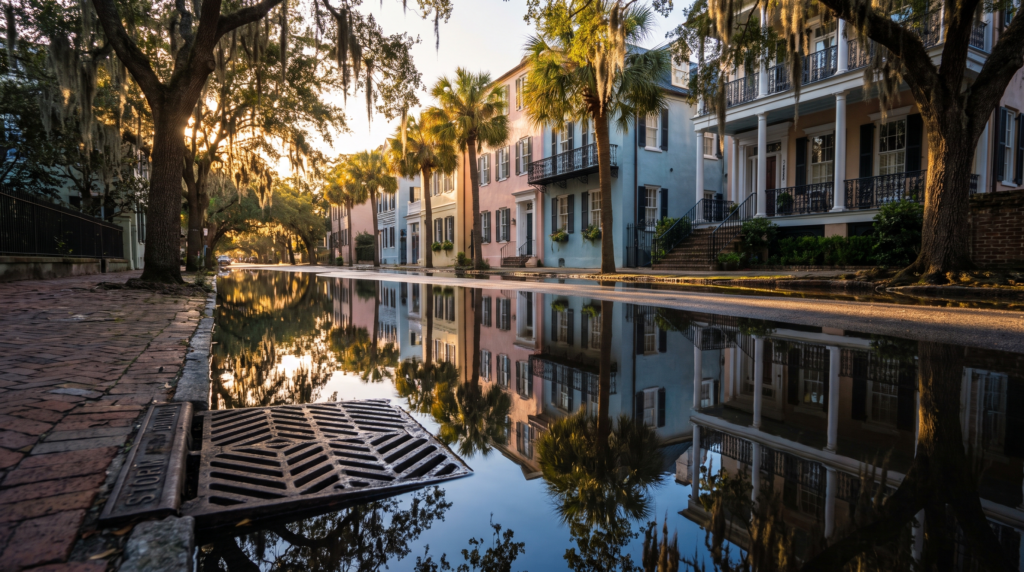
Charleston sits barely above sea level, and the water table is close to the surface. On a king tide the drainage and sewer systems have nowhere to push, and the lowest drain in the house becomes the relief point. That is why we wrote about why king tides back up Charleston drains. A sump pump that has quietly quit turns the same tide into standing water under the house.
Slabs, crawl spaces, and pipes you cannot see
A supply line under a slab can leak for weeks without showing a puddle. What you get instead is a warm spot on the floor, a water bill that climbs for no reason, or the sound of water with everything turned off. That calls for slab leak detection rather than exploratory demolition, and our guide to finding a hidden water leak covers the signs that come first.
Cast iron, clay, and old roots
Peninsula houses and older Old Village properties still run original cast iron and clay waste lines. Both corrode and crack with age, and live oak roots find the cracks. The failure usually announces itself as repeat backups in the same fixture long before it becomes an emergency, which is the moment to look rather than to plunge again.
Storm season
From June through November, one storm can mean lost power, a dead sump pump, and a drainage system under load all at the same hour. Our hurricane season plumbing prep checklist is the version of this article to read before a storm rather than during one.
What an After-Hours Call Costs, and What the Estimate Covers
This is the question people are really asking at midnight, and the honest answer is that the repair drives the price far more than the hour does. Clearing a blockage at an accessible cleanout is not the same job as cutting out a split line inside a wall, and nobody can price either one accurately over the phone without knowing what they are walking into.
What you can ask for, every time, is the structure. Charles Towne Plumbing works from upfront, flat-rate pricing with a clear estimate before any work starts, so the figure you approve is the figure for the job rather than a meter running while the work does. Ask any company you call for the same thing, ask for it in writing, and ask what the diagnostic visit covers before you agree to it.
If predictable suits you better than reactive, an annual maintenance membership puts the house on a schedule, which is where a good share of 2 a.m. calls quietly get prevented. For the repairs that arrive without warning, such as a failed heater or a collapsed sewer line, financing options are worth understanding before you need them rather than at the kitchen table at 3 a.m.
Who Answers at 2 a.m. in the Lowcountry
Charles Towne Plumbing is locally owned and staffed around the clock, on one line: (843) 212-4111. Licensed plumbers, two addresses in the metro at 4952 Rivers Ave in North Charleston and 383 Sumter St in Charleston, and sixteen communities covered across Charleston, Dorchester, and Berkeley counties, from downtown out to Kiawah, Seabrook, Awendaw, and Summerville. You can check yours on the communities we serve, and our around-the-clock emergency page for Charleston has the short version of what to do while you wait.
When you call, have three things ready: what you shut off, what you are seeing right now, and where in the house it is. That is usually enough for a plumber to tell you what to do next over the phone. If it turns out the problem can wait and you would rather not talk tonight, send the details through our contact page instead. Either way, shut the water off first. Everything after that gets easier.
Frequently asked questions
How much is an emergency plumbing visit?
The repair drives the cost far more than the clock does. A blockage cleared at an accessible cleanout, a split supply line opened up inside a wall, and a failed water heater in an attic are three very different jobs. Charles Towne Plumbing quotes upfront, flat-rate pricing with a clear estimate before the work starts, so you approve a figure for the job itself. Ask any plumber what the diagnostic visit covers before you agree to it.
What is the hourly rate for a plumber in South Carolina?
Rates vary by company, and many plumbers in the Charleston market, including Charles Towne Plumbing, price by the job instead of by the hour. Flat-rate pricing means the estimate you approve covers the repair whether it takes one hour or three, which removes the guesswork for you and the pressure to rush for the plumber. If a company quotes hourly, ask what the minimum is and whether travel and parts are included.
Can I turn my water back on after shutting it off at the main?
Only if you know where the water was going and the leak is now isolated behind a closed fixture valve. Open the main slowly, then walk the house and listen. If you hear water with every fixture closed, or the meter dial keeps creeping, shut it back off and leave it off. A house goes a few hours without water far more comfortably than it dries out a wall cavity.
Is a sewage backup my responsibility or the utility’s?
In most systems the utility maintains the main in the street and the property owner maintains the lateral that runs from the house to it. Your utility can tell you which side a blockage is on, and a backup affecting several homes at once points toward the main. On your side of the line, a camera inspection shows whether the cause is grease, roots, or a failed section of pipe. Treat the wastewater itself as a health hazard either way, and keep children, older adults, and anyone immunocompromised out of the affected rooms.
Does homeowners insurance cover water damage from a burst pipe?
Policies differ, and only your carrier can tell you what yours covers. What helps in every case is documentation: photograph the source, the standing water, and the damaged materials before anything is torn out or dried, note the time you shut the water off, and keep the plumber’s estimate and invoice. Call your carrier the same day rather than waiting for the repair to finish.