Every fall, Charleston homeowners call about drains that have suddenly stopped behaving. Toilets that flush slowly for a few hours and then work fine. A shower that gurgles for no reason. A faint sewer smell in the downstairs bathroom that comes and goes.
Often nothing is wrong with the plumbing at all. The tide is in.
What a king tide actually is
King tide is the informal name for the highest tides of the year, when the sun and moon line up and their gravitational pull combines. Charleston gets them predictably, and the biggest ones cluster in the fall — roughly September through November, which is also when we are most likely to get a coastal storm stacking surge on top.
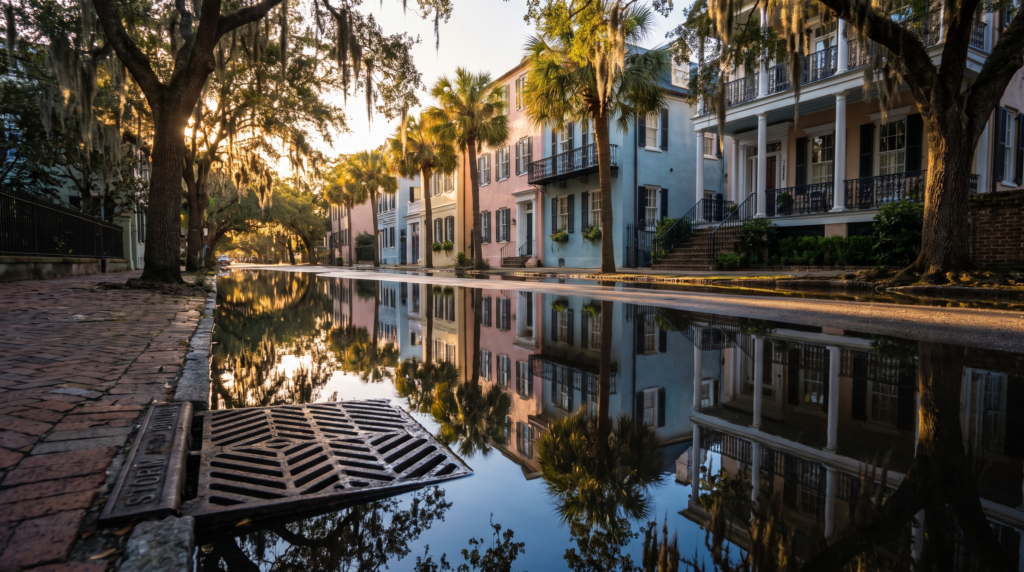
The peninsula sits low and the water table is shallow. When the tide comes up, it does not only come over the seawall. It comes up through the ground and back through the drainage system.
Why your drains slow down when the water rises
Your house drains by gravity into a lateral, which drains into the municipal main. That whole system depends on somewhere downhill for the water to go.
During a king tide, several things happen at once:
The outfall is submerged. Stormwater outfalls that normally discharge into the harbor are underwater. Water cannot leave, so streets flood even without rain.
Groundwater infiltrates the sewer. A high water table pushes water into every crack, bad joint and failed connection in the sewer system. The main fills with water that was never supposed to be in it.
The main surcharges. Now the main is full and under pressure. Your lateral has nowhere to drain, so your fixtures slow, air gets trapped and pushed back up through traps, and you get gurgling and smells. In the worst case the main pushes waste back toward the lowest fixture in your house.
That is why the timing is the clue. If the problem tracks the tide chart rather than your household routine, the pipe under your yard is probably fine.
Telling tidal from an actual clog
Points to tidal influence:
- It comes and goes on a rhythm, and clears on its own after a few hours
- It is worse around the new and full moon, and during fall high tides
- Neighbors on the same block mention the same thing
- Streets nearby are holding water without any rain
- Multiple fixtures gurgle at once, then all recover together
Points to a real problem in your line:
- It is getting steadily worse regardless of tide
- Only your house is affected
- Backups need clearing and then return
- There is a smell or a soft, unusually green patch in the yard
The two also compound. A lateral with root intrusion or a sagging section copes in ordinary conditions and fails during a king tide, because the tide removes all the margin. Our guide to sewer line repair in Charleston covers the difference in detail.
What you can actually do about it
Install a backwater valve
This is the real answer for a low-lying property. A backwater valve is a one-way gate on your lateral: waste flows out, and when the main surcharges, the flap closes and holds it back. For homes in downtown Charleston, James Island and other low-lying areas with a history of backups, nothing else protects as directly.
It needs a suitable install location and periodic inspection to make sure the flap still seats. It is not fit-and-forget.
Get the lateral inspected before the fall tides
A line in good condition handles tidal pressure far better than one already compromised. A camera inspection tells you which one you have, and root intrusion cleared in September is a far smaller job than a backup in October.
Go easy on the drains during peak tide
If the main is already surcharged, running laundry and dishwashers adds volume to a system that cannot take it. Hold the heavy water use until the tide drops. Not elegant, but it works.
Keep the sump pump ready
Groundwater rises during king tides whether or not it rains. Test the pump, and consider a battery backup if you are in a flood-prone spot. Sump pump service before the fall tides is well-timed.
Watch the tide predictions
NOAA publishes tide predictions for Charleston Harbor, and the City flags expected tidal flooding. Knowing a nine-foot tide is coming Thursday afternoon is enough to move the laundry and the car.
Find out which one you are dealing with
If your drains slow down on a schedule, it is worth knowing whether that is the harbor or your lateral. Charles Towne Plumbing handles camera inspections, backwater valves, sewer repair and emergency service across the Lowcountry, and we deal with tidal properties constantly.
Get in touch before the fall tides peak.