Sewer line problems are the repair homeowners put off longest, because for a while the symptoms are easy to explain away. One slow drain is a clog. Two slow drains on the same floor is a coincidence. By the time it is obvious, it is usually not a small job anymore.
Here is how to tell the difference between a clog and a failing lateral, and what your repair options are in Charleston.
Clog or collapsed line?
A clog is local. A sewer line problem affects everything downstream of it. The distinction matters because it changes who you call and what you spend.
It is probably a clog if one fixture is slow and everything else drains fine, and if a plunger or a snake fixes it for a good while.
It is probably the sewer line if:
- Multiple fixtures are slow at once, especially the lowest ones in the house
- Flushing a toilet makes water bubble up in a tub or shower
- You hear gurgling from a drain when a different fixture is used
- Backups keep returning within weeks of being cleared
- There is a sewage smell in the yard, or one patch of lawn is unusually green and lush
- The ground has settled or gone soft along the line between the house and the street
That last pair — the lush grass and the soft ground — means waste is leaking into the soil. It is not a maybe.
Why Charleston laterals fail
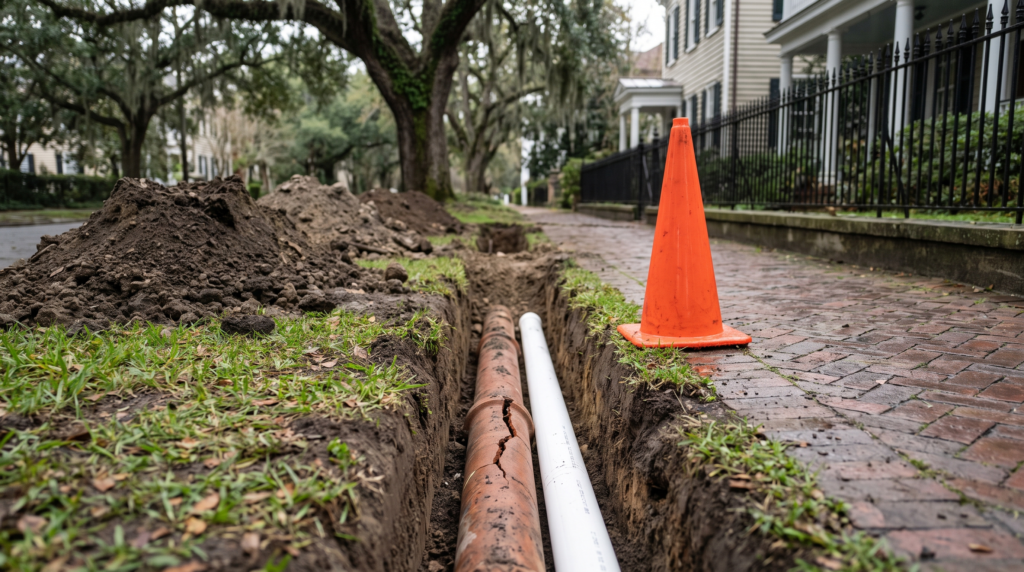
Roots. The live oaks that make Charleston streets beautiful send roots toward the nearest reliable water, and a joint in an old clay lateral leaks just enough to attract them. Roots enter at a hairline crack, grow, and eventually fill the pipe.
Pipe age and material. Homes built before roughly 1970 often have clay or cast iron laterals. Clay joints separate as soil shifts. Cast iron corrodes from the inside until the bottom of the pipe is gone. Orangeburg — a tar-paper pipe used mid-century — deforms into an oval and collapses. All three are past their design life.
Ground movement and a high water table. Soft Lowcountry soil, a shallow water table and periodic saturation all put a buried line under stress that firmer ground does not.
Storm season. September and October are when we see the most sewer calls. Saturated ground shifts, roots chase moisture aggressively after heavy rain, and a surcharged municipal main pushes back against a lateral that was already compromised. A line that coped all summer often gives up right after a big storm.
Diagnosis comes before any quote
Nobody can recommend a sewer repair honestly without seeing inside the pipe. A sewer camera inspection is run through a cleanout and shows the material, the condition, exactly where the problem is, how deep it sits and how far from the house.
That footage is what separates a spot repair from a full replacement. Be wary of any recommendation for a line replacement made without it.
Your repair options
Clearing and root cutting
Mechanical cutting or hydro jetting to clear roots and buildup. This restores flow but does not repair the pipe — roots return through the same crack. Reasonable as maintenance on a line in otherwise sound condition, or as a stopgap while you plan a real repair.
Spot repair
Excavate and replace one damaged section. Sensible when the camera shows a single localized failure in an otherwise healthy line. How involved it gets depends heavily on depth and what sits above it — a section under grass is a very different job from one under a driveway or a historic brick walk.
Trenchless pipe lining (CIPP)
A resin-saturated liner is pulled into the existing pipe and cured in place, forming a new jointless pipe inside the old one. No joints means no root entry. It usually needs only small access points instead of a trench across the yard, which matters enormously on a downtown lot with mature landscaping, brick or a historic streetscape. It requires the host pipe to still hold its shape — a fully collapsed line cannot be lined. We explain the method in how the pipe relining process works, and compare cure methods in Picote epoxy versus UV inversion CIPP.
Full excavation and replacement
Open the trench and lay new pipe. Necessary when the line has collapsed, lost too much grade, or is Orangeburg that has already deformed. The most disruptive route, but sometimes the only correct one.
What determines the right method
Sewer work varies more than almost any other plumbing job. The variables that decide which approach fits your property:
- Length of the run from the house to the city main
- Depth — deeper means more excavation, and in Charleston often means dewatering
- What is on top — lawn, driveway, mature oak roots, brick walk, or street
- Permits and traffic control, particularly downtown
- Historic district requirements, which can restrict methods and add time
- Condition of the host pipe, which decides whether lining is even an option
- Restoration — putting the surface back is part of the job, not an afterthought
This is a large part of why trenchless is so often the better answer on a Charleston lot: there is far less surface to put back, and mature landscaping and historic hardscape stay where they are.
Get eyes in the pipe first
If you are seeing gurgling, repeat backups or a soft patch in the yard, the next step is a camera, not a quote. Charles Towne Plumbing handles sewer and septic line repair and trenchless solutions throughout the Charleston metro.
Schedule an inspection and we will show you the footage before we discuss the fix.