A hidden water leak rarely announces itself. It shows up as a bill that climbed for no reason, a warm patch on a tile floor, or the sound of water moving through the walls of a quiet house at midnight. If you have typed “water leak detection Charleston SC” into a search bar, you are probably in the gap between suspecting a leak and knowing where it is. Here is how to read the early signs, a meter test you can run yourself in about ten minutes, and how a licensed plumber pinpoints a leak without tearing up your floors or your yard.
The signs a Lowcountry home gives before a leak surfaces
Water takes the easiest path, and in a house that path is usually out of sight. Watch for:
- A water bill that jumps while your habits stay the same.
- The sound of running water when every fixture is off.
- A warm or damp spot on a slab floor, or one tile that stays dark.
- A musty smell in a cabinet, a closet, or the crawl space.
- Paint or baseboard that bubbles, cups, or stains with no obvious source.
- A stripe of lawn greener than the rest, or ground that stays soft after a dry week.
- Hot water that takes longer to arrive, or pressure that has quietly dropped.
Our humidity hides two of those. A damp cabinet in August reads as ordinary Charleston air, and soft ground reads as yesterday’s storm. If a sign repeats during a dry stretch, treat it as a leak until something proves otherwise, and read up on what plumbing leak repair involves.
The meter test: ten minutes, no tools
Before anyone comes out, you can confirm whether water is moving when it should not be. Charleston Water System describes the same check on its high bills and leaks page.
- Shut off every faucet, appliance, and ice maker, and ask the household to leave the water alone for the duration.
- Find your meter, usually in a box in the grass strip near the curb.
- Look at the low-flow indicator, the small triangle or dial that turns on the slightest movement. If it spins, water is going somewhere.
- If it sits still, write down the reading, wait an hour or two with no water used, and read it again. Any change means a leak.
- To narrow it down, close the main shutoff valve to the house and repeat. If the meter still moves, the leak is between the meter and the house. If it stops, the leak is inside.
A still meter does not clear the house completely. An irrigation zone, a toilet flapper that leaks on and off, and very slow drips can all pass this test. What it does give a plumber is a place to start.
What water leak detection in Charleston, SC actually involves
Good leak work narrows the search before anything gets opened. The trade does that by isolating sections of the system and watching pressure, by listening along supply lines for the sound a pressurized pipe makes where water escapes it, and by comparing temperature across a slab to find where hot water is running under concrete. The goal of non-invasive leak detection is to arrive at one spot to open rather than a wall to explore.
Charles Towne Plumbing works both sides of the meter this way, from a pinhole under a Mount Pleasant slab to a service line failing in a peninsula yard. Our guide to finding a hidden water leak in a Charleston home walks through that sequence in more detail, and slab leak detection covers the hardest version of the job.
Why a leak under the slab is the one to hurry on
Slab-on-grade construction is common across Mount Pleasant, Summerville, and Goose Creek, and a supply line that fails under that concrete has nowhere to drain. The water saturates the soil beneath the slab instead. In a place where the water table already sits close to the surface, that soil has little room to take it, and what follows is some mix of a steadily rising bill, damp flooring, warm spots underfoot, and, in a leak left alone long enough, movement in the slab itself.
Older peninsula and West Ashley houses fail differently. Galvanized and cast-iron pipe corrodes from the inside, so the first pinhole is usually followed by others along the same run. At that point a planned water line repair or replacement of the run costs less over a few years than a third patch in two.
What happens once the leak is found
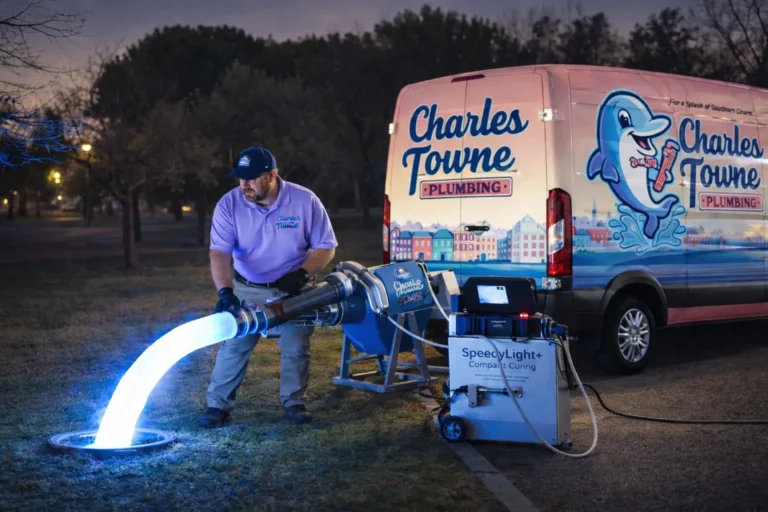
The fix depends on what failed. A pinhole in a reachable supply line is a spot repair. A deteriorating run under a slab is often rerouted overhead or through a wall rather than jackhammered out. If what you are seeing turns out to be wastewater rather than supply water, trenchless pipe lining can rebuild a drain or sewer pipe from the inside through existing access, which matters where a driveway or a live oak sits over the line. Charles Towne Plumbing keeps that work in house through its sister company, Carolina Relining Solutions, and confirms the cured liner with a camera pass afterward.
Treat surfacing wastewater as a health hazard rather than a mess. Sewage carries pathogens, and children, older adults, and anyone who is immunocompromised face the highest risk from exposure, so keep them away from the water and the wet flooring until it has been cleaned up properly. Our piece on sewer line backups in Lowcountry homes covers that side of it. Whichever repair you end up needing, you get upfront, flat-rate pricing and a clear estimate before we start.
What can wait until morning, and what cannot
A dripping faucet can wait. Water you cannot stop cannot. If water is running somewhere you cannot reach a fixture shutoff, close the main valve to the house, then call. Find that valve tonight rather than during the emergency. The line at Charles Towne Plumbing is (843) 212-4111, answered around the clock, because a leak behind a wall keeps no business hours. Our companion guide on what to shut off after hours sorts the rest of the house by urgency.
One exception is not a plumbing call at all. If you smell gas, get everyone out of the house. Do not flip switches, use a phone, or touch appliances inside. From a safe distance down the street, call the gas utility or 911. A plumber repairs the gas system afterward, once the utility has contained the danger.
Finding the leak before it finds your floors
A hidden leak is cheapest on the day you first suspect it. Run the meter test, write down what you saw, and call while the evidence is fresh. Charles Towne Plumbing is locally owned, with licensed plumbers working out of North Charleston and downtown Charleston across sixteen communities in Charleston, Dorchester, and Berkeley counties, and you can see the full list of communities we serve. We would rather find a leak for you this week than dry out a floor for you next month.
Frequently asked questions
How much does water leak detection cost?
It depends on how the leak has to be found: a meter test and a visual check are quick, while isolating a line under a slab takes longer. Charles Towne Plumbing quotes upfront, flat-rate pricing with a clear estimate before any work starts, so you approve the number before a tool comes out of the truck.
How can I find out where a water leak is coming from?
Start at the meter. Turn off every fixture and appliance, then watch the low-flow indicator; if it moves, water is escaping somewhere. Close the main shutoff and check again to tell an outside leak from an inside one. From there, a plumber isolates sections of the system and listens along the lines to narrow it down to one spot.
Can a hidden water leak damage a concrete slab?
Yes. A supply line that fails under a slab has nowhere to drain, so the water saturates the soil underneath. In the Lowcountry, where the water table sits close to the surface, that soil has little capacity to absorb more. Over time this can show up as damp flooring, warm spots underfoot, and movement in the slab itself.
Does homeowners insurance cover a slab leak?
Coverage varies by policy. Many homeowners policies treat sudden water damage differently from the cost of repairing the pipe that caused it, and a slow, long-running leak is often handled differently again. Read your policy or ask your agent before the work is scheduled, and keep photos and the plumber’s written findings.
Is water running in the walls at night an emergency?
If you cannot stop it, treat it as one. Close the main shutoff valve to the house, which keeps the damage from growing while you wait, and call. Charles Towne Plumbing answers a single line around the clock at (843) 212-4111. If what is surfacing is sewage rather than clean water, keep children and older adults away from it entirely.