Warren
December 5, 2025
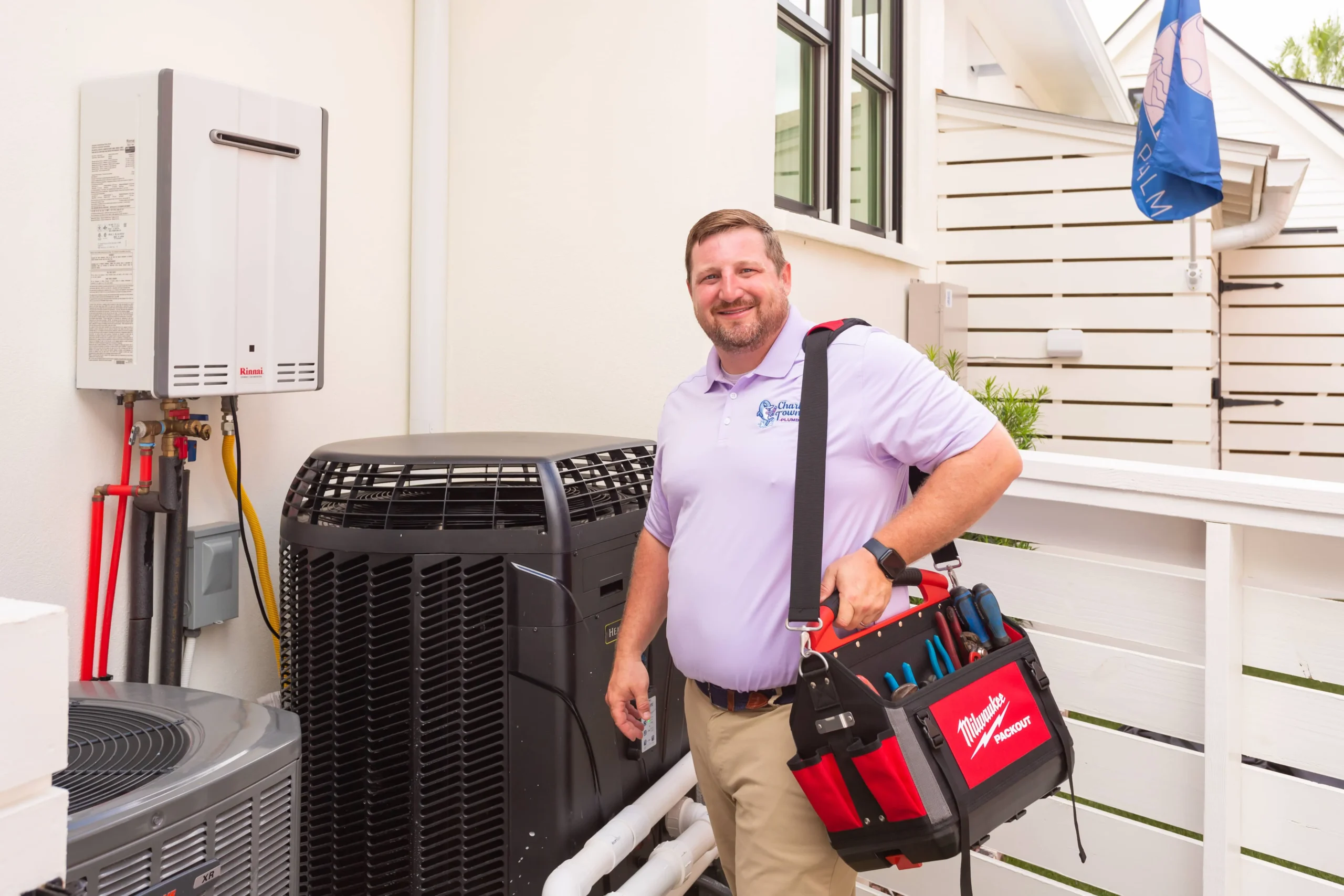
Tankless water heaters — also called on-demand or instantaneous water heaters — heat water only when a tap is opened, eliminating standby losses associated with storage tanks and delivering near-continuous hot water on demand. This article explains why Charleston homeowners might choose a tankless hot water heater by covering how the technology works, energy and space savings, common local installation considerations, likely costs, maintenance needs, and sizing guidance tailored to Charleston’s climate and water conditions. Many homeowners wrestle with rising utility bills, limited mechanical space, and concerns about tank leaks; tankless systems can reduce energy use, free up space, and lower flood risk while offering a longer service life when maintained properly. You will find clear comparisons to traditional storage tanks, a step-by-step installation checklist including permit checkpoints, troubleshooting and maintenance advice for hard-water areas, and examples of local repair/installation resources. Throughout the guide I use terms like UEF, GPM, BTU, and common component names so you can match system specs to household needs and discuss options confidently with installers.
A tankless water heater provides hot water on demand by passing cold water through a heat exchanger that activates only when flow is detected, which reduces standby energy loss and can result in measurable efficiency gains for many households. The mechanism — a flow sensor triggering a gas burner or electrical element to raise temperature — delivers continuous hot water subject to the unit’s GPM capacity, and the primary homeowner benefits are lower operating losses, reduced footprint, longer expected lifespan, and less flood risk compared with tanks. In Charleston’s humid, coastal climate, space-saving wall-mounted units and the reduced volume of stored water address both limited mechanical-space problems and the consequences of corrosion or tank failure. The paragraphs below expand on how endless hot water works and how energy savings translate to annual dollar reductions.
Tankless systems offer several distinct benefits for Charleston homeowners:
These benefits make tankless systems an attractive alternative where energy focus, space constraints, and flood risk matter; next we’ll explain how on-demand heating actually delivers continuous hot water in practical household scenarios.
A tankless unit heats water as it flows through a heat exchanger, using either a gas burner or electric heating elements that activate based on a flow sensor and thermostat setting. The system’s capacity to provide “endless” hot water depends on its rated gallons-per-minute (GPM) and the required temperature rise from Charleston’s incoming water temperature to the set point. For example, a unit rated at 6 GPM can typically run a shower and a dishwasher simultaneously at moderate temperature rises, while higher-demand households will need a multi-modular or higher-BTU/kW model. The heat exchanger and flow-control logic maintain set temperatures by modulating fuel or power, but when demand exceeds rated GPM the water temperature will drop — a design trade-off compared with storage tanks. Understanding GPM and temperature rise is essential when sizing for peak simultaneous use in local homes.
This flow-based heating approach leads directly to energy savings, which we explore next to quantify likely utility bill reductions for different Charleston usage patterns.
Tankless water heaters reduce energy losses by eliminating standby heat loss from stored hot water and by operating only during use, which often produces a higher UEF (Uniform Energy Factor) than older storage tanks. Recent analyses and Department of Energy summaries indicate household savings vary widely: typical natural-gas-using families may see around 8–14% annual water heating energy savings, with greater gains in households that use less hot water or have multiple short draws rather than long continuous draws. Translated to dollars, savings depend on local energy prices and fuel type, but many moderate-usage households can expect meaningful year-over-year reductions that shorten payback time when paired with appropriate installation. The efficiency advantage interacts with Charleston’s mild groundwater temperatures, often lowering required temperature rise compared with northern climates and therefore improving delivered hot water capacity and efficiency.
These savings estimates set up practical comparisons with traditional tanks, which we’ll examine in the next section to help you weigh upfront cost versus long-term operating expense.
A tankless water heater differs from a traditional storage tank in three core ways: on-demand heating versus stored supply, higher initial equipment cost but lower standby losses, and differing maintenance profiles focused on heat-exchanger care instead of anode-rod replacement. In Charleston, local factors like inlet water temperature, hard-water mineral content, and space constraints influence which system yields lower total cost of ownership. Tankless units typically have longer manufacturer-rated lifespans and smaller footprints, while tanks offer higher peak flow for lower upfront cost; the choice depends on household hot-water patterns and budget constraints. The following table compares key attributes to help homeowners assess trade-offs.
This comparison shows tankless units generally win on longevity and footprint, while storage tanks often win on simple upfront cost and high single-unit peak flow. Next we’ll break down installation and operating cost differences in more detail.
Installation and operating costs differ because tankless systems often require upgraded venting, gas-line sizing or significant electrical service, plus more complex labor for mounting and commissioning; storage tanks usually have simpler plumbing and venting needs. Typical cost drivers include the unit price, venting materials and run length, gas-line or electrical upgrades, labor rates, and permit/inspection fees. Operating costs favor tankless where standby losses are significant and where the household pattern includes lower baseline demand, but high simultaneous usage can push operating costs if oversizing or multiple units are required. Carefully accounting for these line items helps estimate payback and informs whether a partial replacement (point-of-use units) or whole-home tankless is appropriate.
The next subsection contrasts performance and maintenance requirements so you can plan long-term service needs and budget for routine care in Charleston’s water conditions.
Performance differences center on flow-rate behavior: tankless units deliver consistent temperatures up to their rated GPM, while tanks supply a full-volume draw until the tank empties and then recover. Maintenance for tankless heaters focuses on descaling, cleaning inlet filters, and inspecting the heat exchanger and venting annually—especially important in Charleston where hard water can accelerate mineral buildup. Storage tanks require periodic anode-rod checks, tank flushing for sediment, and corrosion monitoring; they also carry a larger immediate flood risk upon failure. Service costs vary, but neglecting tankless descaling in hard-water areas commonly leads to reduced efficiency and premature heat-exchanger issues, making proactive maintenance crucial.
To make installation choices practical, the next section walks through local permit considerations and installation steps for Charleston homeowners.
A proper tankless installation begins with a site assessment to confirm fuel availability, venting options, and required flow and temperature-rise calculations, followed by permit filing, professional installation, and final inspection. The mechanism and benefit are simple: matching rated GPM and BTU/kW to household peak demand prevents underperformance, while correct venting and combustion-air pathways ensure safe operation. Key considerations for Charleston include elevated exposure to humid air, potential for salt air corrosion on external venting, and local permit or inspection nuances that may affect scheduling. Homeowners should arrange a licensed technician for the site survey and to obtain the necessary permits; local service providers like LimRic, Smoak’s Comfort Control, Preferred Home Services, Rapid Repairs, and Pardee Service Experts operate in Charleston and can perform assessments and permit-supported installations.
These steps help ensure permits and code requirements are met and that the installation timeline is realistic; the table below breaks down installation cost factors and sample ranges for Charleston to aid budgeting.
Understanding these line items helps homeowners evaluate quotes and anticipate additional costs such as rerouting ducts or upgrading panels, which we discuss next when contrasting gas and electric installations.
Typical installation steps start with a pre-install survey to verify inlet temperature, fuel types, venting route, and service capacity, and then proceed through permit submission, installation, and final inspection to ensure compliance. The mechanism includes documenting gas-line sizes, vent terminations, and condensation management for condensing units, all of which municipalities commonly review during permitting. Charleston homeowners should expect inspection items around combustion air, vent termination placement, and safe condensate disposal; permit timelines vary, so scheduling the site survey and permit submission early shortens overall project duration. The best practice is to have a licensed installer prepare permit-ready drawings and submit applications on your behalf to avoid delays.
These steps set realistic expectations for timing and preparation; next we contrast gas and electric installation differences to help choose the right fuel type.
Gas-fired tankless units require combustion venting, adequate combustion air, and correctly sized gas piping to deliver BTUs during peak demand, while electric tankless heaters need substantial amperage and often dedicated circuit(s) or panel upgrades. The mechanism difference — combustion vs electrical resistance — produces trade-offs: gas units typically deliver higher peak GPM at lower upfront energy cost per BTU for many homes, but they require safe venting and combustion clearances; electric units are simpler to vent but can demand expensive electrical service upgrades for whole-home solutions. In Charleston, fuel availability and local electricity rates influence operating cost calculations, while salt-air exposure may favor protected venting choices. Evaluating existing fuel service and panel capacity during the site survey avoids scope creep and unexpected upgrade costs.
Choosing between gas and electric depends on household demand, existing infrastructure, and tolerance for venting work; the following section details maintenance and common problems to help plan long-term ownership.
Common tankless issues include mineral scale buildup on the heat exchanger, cold-water sandwich (short bursts of cold water during toggled draws), ignition and flow-sensor faults, and venting or condensate problems; each arises from predictable mechanisms and has specific remedies. Mineral buildup is driven by hard water and reduces heat-exchanger efficiency over time, while combustion and control errors often show as error codes or intermittent hot-water loss. Preventative maintenance — annual descaling, inlet-filter cleaning, and vent inspections — avoids many failures, and recognizing warning signs early limits repair scope. In Charleston’s water profile, proactive schedule-based maintenance is more important than in soft-water regions, and professional service plans reduce downtime risk.
Signs that indicate repair needs include persistent error codes, sudden loss of hot water across multiple fixtures, fluctuating outlet temperatures during normal demand, unusual noises from the unit, and visible water leaks or drips around connections. Each symptom maps to likely causes: error codes often point to sensors, ignition, or flow-sensor faults; intermittent temperature swings suggest scale or control issues; and leaks indicate plumbing or heat-exchanger problems. Homeowners should shut off water to visible leaks and power down the unit when a serious leak is suspected, then arrange licensed service to diagnose and repair problems. Prompt service reduces the risk of heat-exchanger damage and prevents prolonged service interruptions.
Knowing when to call a professional also reduces unnecessary attempts at DIY fixes that could void warranties or create unsafe conditions, which is why scheduled annual maintenance is usually the best prevention strategy.
Professional maintenance is important because technicians perform tasks that preserve heat-exchanger integrity and operational efficiency: controlled descaling or chemical flushing, inspection of burners or elements, cleaning inlet filters, verifying venting and condensate traps, and testing safety interlocks and sensors. The reason it matters is clear: neglected scale and blocked vents reduce efficiency and can cause permanent damage to expensive heat exchangers, shortening the system’s useful life and increasing lifetime cost. A formal maintenance visit also documents service history, which many warranties require for full coverage and claims. Investing annually in professional care yields better uptime, more consistent energy savings, and longer equipment life.
Regular professional servicing complements homeowner checks and is especially critical in Charleston where hard water and coastal air can compound wear patterns.
Choosing the right tankless water heater depends on accurately sizing for peak simultaneous demand (GPM) and temperature rise, selecting a brand and model suited to local conditions, and prioritizing available service networks and warranty terms. The mechanism for sizing is straightforward: tally typical fixture flows to estimate peak GPM, calculate required temperature rise from measured inlet water temperature to desired output, and match those figures to a model’s rated GPM at that temperature rise. Brands offering condensing and non-condensing models each have pros and cons for Charleston — condensing units are more efficient but require careful condensate routing. Below is a practical sizing table to translate model ratings to household needs.
Use this sizing guide together with a local inlet-temperature measurement to pick a model that maintains temperature with headroom for simultaneous draws. Next, practical steps to calculate GPM and BTU needs help you create an accurate spec for installer bids.
Sizing involves three steps: list peak simultaneous fixtures and their typical GPM contributions (e.g., shower 1.5–2.5 GPM, dishwasher 1–2 GPM), sum those flows to get peak GPM, and compute temperature rise by subtracting Charleston’s average inlet temperature from the desired hot-out temperature. Convert the required temperature rise and GPM into BTU/hr (for gas) or kW (for electric) to select a model whose rated output meets or exceeds that demand. For example, a two-bath household with simultaneous shower (2.0 GPM) and dishwasher (1.5 GPM) equals ~3.5 GPM; with a 60°F inlet and a 120°F setpoint, the needed temperature rise is 60°F and the corresponding BTU/kW requirement guides model selection. Accurate sizing avoids underperformance and prevents overspending on unnecessarily large units.
This calculation is an essential step before soliciting installer quotes and determines whether single or multiple units are the best approach.
Reputable brands often cited in the marketplace include manufacturers known for robust service networks and models in condensing and non-condensing categories; practical choices for Charleston should weigh corrosion-resistant venting options and readily available local service. The hyponyms to consider are gas-fired tankless water heaters, electric tankless units, condensing models for higher efficiency, and point-of-use heaters for targeted installs; each has service and warranty implications. Local installers and service networks (e.g., those noted earlier) often favor certain brands based on spare-part availability and technician training, so checking installer familiarity and warranty transferability is important. Selecting a brand with an established local service footprint reduces response time for repairs and simplifies annual maintenance scheduling.
Typical installed costs for tankless systems vary widely because of unit capacity, venting complexity, and required fuel or electrical upgrades; however, the financial benefit often comes from lower annual operating costs and longer service life when maintenance is kept current. The mechanism behind the savings is reduced standby loss and improved UEF, and the result is annual energy savings that depend on household patterns and fuel prices. Homeowners should obtain itemized bids to compare unit cost, venting, gas-line or electrical upgrades, labor, and permits side by side with tank replacement quotes. While precise local rebates or financing offers change over time, transparent line-item estimates help calculate simple payback based on conservative annual savings.
Major cost drivers include the unit price (which scales with rated GPM and BTU/kW), venting materials and run length (especially for condensers or long exterior runs), gas-line or electrical upgrades to meet peak demand, labor complexity for wall-mounting and condensate management, and permit/inspection fees with local authorities. Other scenario-based costs include relocation of the unit, adding a buffer tank for very low-flow stability, or installing a water-softening/pre-treatment system to reduce scale. Homeowners can reduce costs by choosing a location close to existing fuel sources and vent terminations and by consolidating other electrical/plumbing work during the same project. Getting multiple itemized quotes and asking installers to document required permit line items makes cost comparison transparent.
Annual savings depend on baseline consumption, fuel prices, and the efficiency differential between the existing unit and the new tankless system; using conservative estimates, households often save in the low-to-mid hundreds of dollars per year on water-heating energy, with larger savings for higher-efficiency condensing models or households that previously used inefficient tanks. For example, an efficiency improvement of 10% on a household spending several hundred dollars annually on water heating yields a multi-year payback that improves further when unit lifespan and reduced replacement frequency are factored in. Use local utility rates and measured usage to run a simple payback: (Installed cost difference) ÷ (Annual energy savings) = years to payback. This transparent math helps determine whether tankless makes economic sense alongside non-energy benefits like reduced flood risk and space savings.
by Warren DeHaven – Owner of Charles Towne Plumbing

Serving Charleston, SC and Surrounding Areas.
See All Locations© 2026 Charles Towne Plumbing. All Rights Reserved. Privacy Policy