Warren
February 16, 2026
Charleston homes often face challenges such as aging cast iron and clay sewer lines, historic downtown properties with limited excavation access, a high water table and coastal soil movement, slab foundation risks, and tree root intrusion from large live oaks. Additionally, excavation frequently damages brick driveways, tabby foundations, patios, irrigation systems, and landscaping, making traditional sewer repairs problematic.
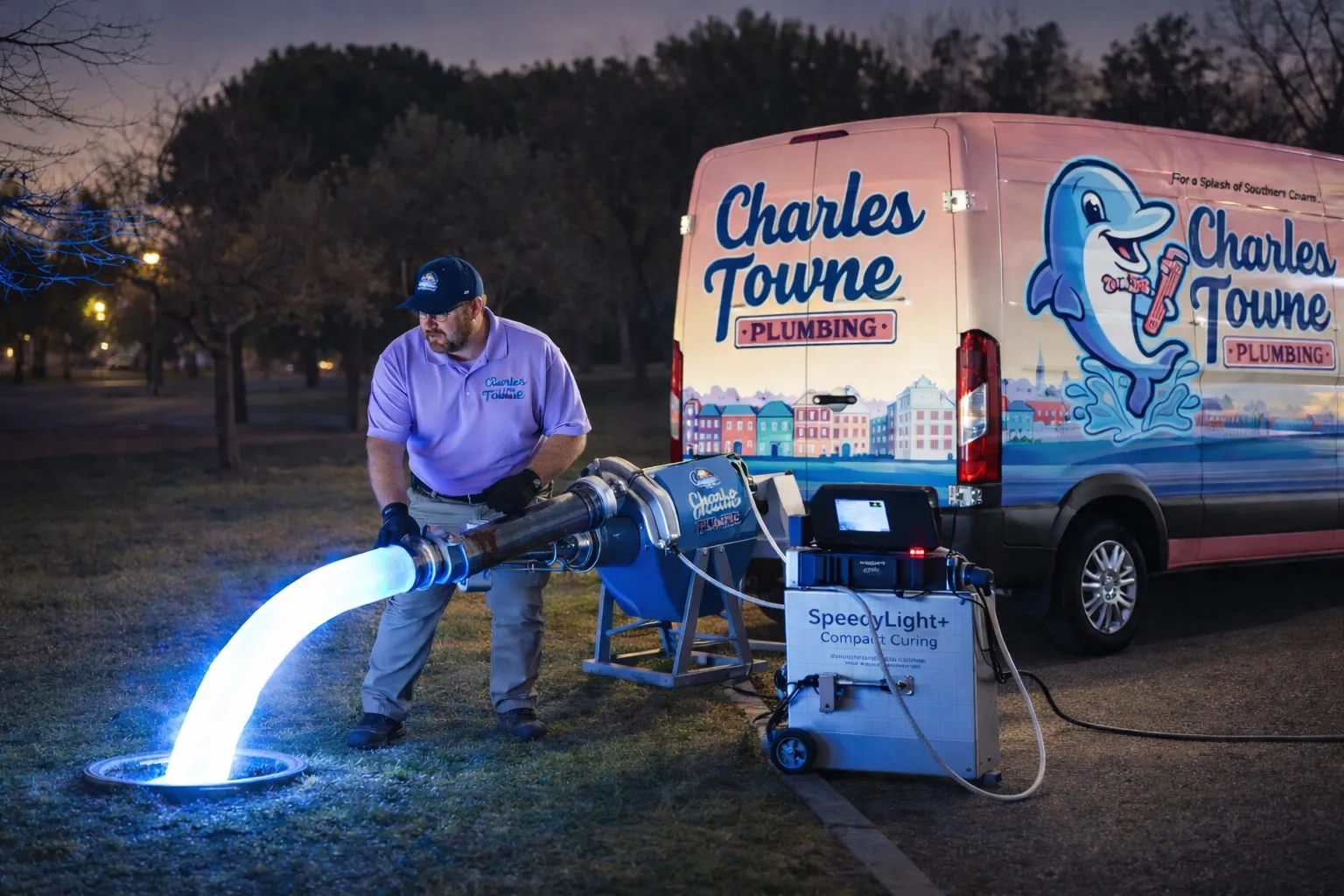
Pipe lining, specifically Cured-In-Place Pipe (CIPP), is a trenchless sewer repair method that creates a ‘pipe within a pipe’ to restore damaged sewer lines with minimal excavation required. The process involves a sewer camera inspection, pipe cleaning and descaling, epoxy liner insertion, and UV curing using the Speedy Light system. This method is suitable for cast iron and clay pipes commonly found in Charleston homes.
Pipe lining provides structural reinforcement, corrosion resistance, seals cracks and joints, prevents root intrusion, and offers a smooth interior that improves flow, effectively extending the life of sewer pipes by more than 50 years.
Live oaks are iconic in Charleston and often legally protected. Their root systems are wide and shallow, making them vulnerable to excavation damage. Severing structural roots can destabilize or cause long-term decline of these trees, potentially resulting in fines for damaging protected trees. Minimal trenching with pipe lining preserves root systems and landscaping, making it ideal for neighborhoods such as South of Broad, Downtown Charleston, Old Village, West Ashley, and James Island.
Pipe lining helps avoid excavation labor costs and prevents driveway and landscaping restoration expenses. It is often completed in one day and results in a lower total project cost over time compared to traditional sewer repair methods.
This method seals cracks and joint separations, eliminates root intrusion, prevents groundwater infiltration, and improves flow capacity, thereby preventing recurring sewer backups.
Pipe lining causes less soil disruption, reduces construction waste, has a smaller carbon footprint, and preserves mature landscaping, making it an eco-friendly and non-destructive solution.
Pipe lining is an appropriate solution for homes experiencing frequent clogs, slow drains throughout the home, sewage odors, wet yard spots, slab foundation plumbing issues, and recurring sewer backups. A sewer camera inspection is required to determine eligibility for pipe lining.
Charlestowne Plumbing offers local Charleston expertise and experience with historic homes. They utilize Speedy Light UV curing technology, are licensed and insured, provide transparent pricing, and serve areas including Charleston, Mount Pleasant, West Ashley, James Island, and North Charleston. Charles Towne Plumbing is locally owned and were the first to bring pipelining technology to Charleston in 2018.
Pipe lining typically extends the life of sewer pipes by 50 years or more.
Yes, pipe lining often costs less overall due to reduced excavation and restoration expenses.
Yes, cast iron pipes are suitable for CIPP pipe lining.
Most pipe lining projects can be completed in one day.
Minimal excavation is required, significantly less than traditional sewer repair methods.
No, pipe lining preserves root systems by minimizing trenching and excavation.
Yes, it is an ideal solution for historic properties due to its non-destructive nature.
Schedule a sewer camera inspection today with Charles Towne Plumbing to assess your sewer system. Emergency services are available. Call now or book online for a free estimate.
Serving Charleston, SC and Surrounding Areas.
See All Locations© 2026 Charles Towne Plumbing. All Rights Reserved. Privacy Policy